Compare Vonr for iPhone on Short Vs. Long Peru Stays
11/18/2026
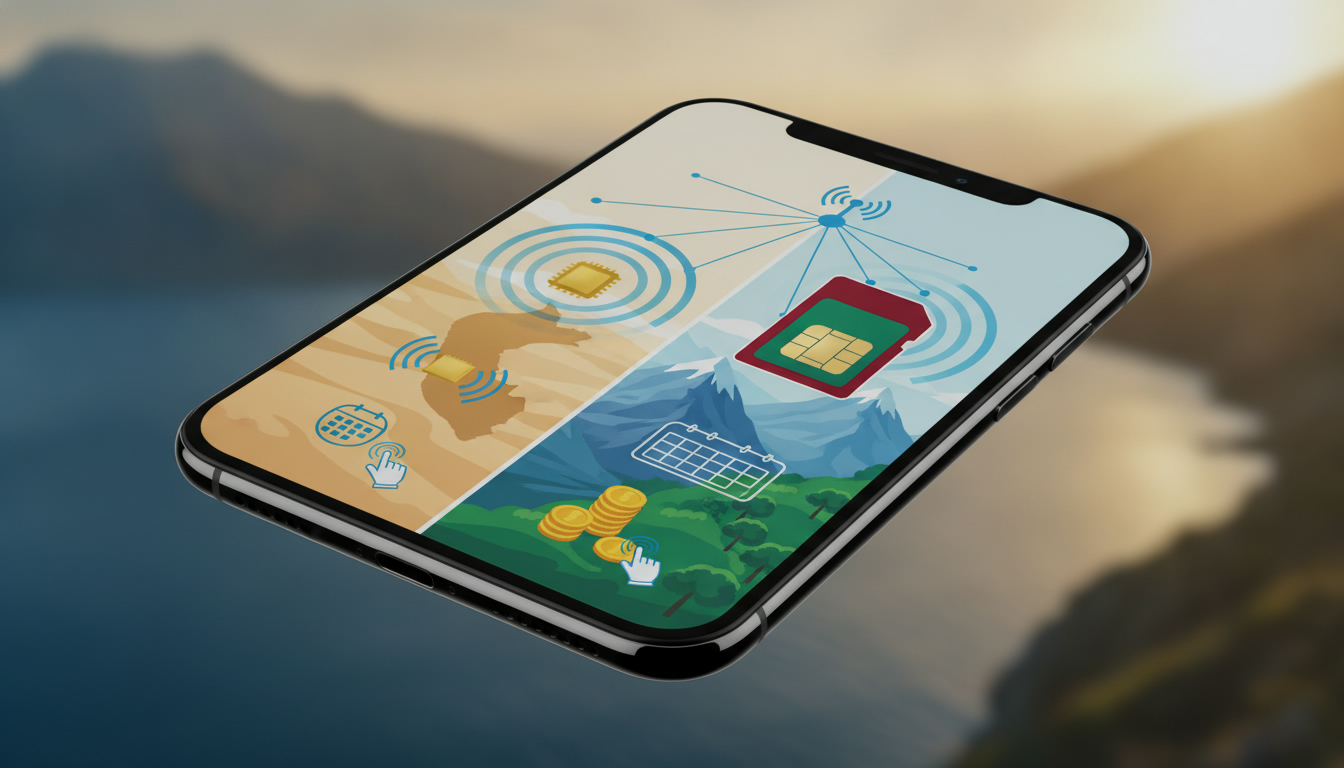
If you searched for “vonr iphone,” the short answer is this: iPhone 13 and newer models have the modem hardware needed for 5G Voice over New Radio, but VoNR only works when your carrier, SIM or eSIM, software profile, and local 5G Standalone network all support it. Owning a compatible iPhone does not activate VoNR by itself.
For a short stay in Peru, I would treat VoNR as a network-compatibility question rather than a feature to chase. For a longer stay, the carrier’s 5G Standalone coverage and voice support matter more because you may rely on the line every day instead of using it only for maps and messaging.
What VoNR changes on an iPhone
VoNR means Voice over New Radio: the call remains on a 5G New Radio connection instead of moving to 4G LTE for voice. The underlying radio standard is 3GPP 5G NR, while the older 4G voice system is commonly called VoLTE, or Voice over LTE.
The practical difference is the network path:
- With VoNR, the phone uses a compatible 5G Standalone core and 5G radio for the call.
- With VoLTE, the phone uses 4G LTE for the call.
- With non-standalone 5G, the phone may display a 5G icon for data but still move voice to LTE.
- With Wi-Fi Calling, the call uses Wi-Fi rather than either cellular voice path.
That last distinction causes much of the confusion. A 5G icon does not prove that the call is using VoNR.
If the carrier has 5G coverage but has not enabled 5G voice, the iPhone can remain on 5G for data and use VoLTE when a call begins.
A field sign helps here: if the phone drops from 5G to LTE as soon as you place a call, the network is using VoLTE, not VoNR. If it remains on 5G, that still is not conclusive unless the carrier confirms 5G Standalone voice support, because some network displays do not expose the voice technology clearly.
VoNR-compatible iPhone models
Apple’s iPhone 13 family introduced 5G-capable hardware that can support the required radio features, and later generations retain 5G capability. The relevant model groups are:
| iPhone generation | 5G hardware | VoNR status |
|---|---|---|
| iPhone 12 family | Yes | Carrier and software dependent; do not assume availability |
| iPhone 13 family | Yes | Hardware is capable; carrier support remains necessary |
| iPhone 14 family | Yes | Hardware is capable; carrier support remains necessary |
| iPhone 15 family | Yes | Hardware is capable; carrier support remains necessary |
| iPhone 16 family | Yes | Hardware is capable; carrier support remains necessary |
The distinction between hardware and service is essential. A modem can support a radio feature while the carrier profile does not expose it.
A discussion about T-Mobile’s iPhone 13 support also illustrates this point: modem capability existed before broad software and network availability.
I would advise against buying a new iPhone solely for VoNR. If your current iPhone already supports 5G, the carrier’s deployment is usually the limiting factor.
Short stay versus long stay in Peru
For a short Peru trip, VoNR should be a secondary consideration. Your priority is a data eSIM that activates without roaming charges and works where you will actually travel.
A 1-day plan listed by MyBestSim is 3 GB for $2.99 from eSIM.DOG, while a 30-day, 3 GB plan from JamboSim is $4.99. Those are data-plan examples, not proof of VoNR support.
| Stay pattern | More useful choice | Why VoNR matters |
|---|---|---|
| 1 day | Short validity data plan | Low; messaging and app calls usually matter more than cellular 5G voice |
| 30 days | 30-day data eSIM | Moderate; confirm voice and SMS needs before relying on the eSIM |
| More than 30 days | Renewable or longer-validity service | High; carrier policy, number retention, and voice availability become important |
For a short stay, a data-only eSIM can be enough if your existing home SIM handles calls through roaming or Wi-Fi Calling. Before departure, turn off data roaming on the home line and select the travel eSIM for cellular data.
This prevents the expensive mistake of leaving the primary line as the data source while assuming the travel eSIM is active.
The mechanism is simple: the iPhone can keep one line registered for calls while assigning mobile data to another line. If the wrong line is selected under Settings > Cellular > Cellular Data, the phone may consume roaming data even though the Peru eSIM is installed correctly.
For a longer stay, check whether the eSIM is data-only. A data-only plan will not automatically provide a local telephone number, SMS, VoLTE, or VoNR.
Internet calls through FaceTime Audio, WhatsApp, or another app may work, but that is not the same as carrier voice.
The Peru travel eSIM options are easier to assess when you separate three questions: how much data you need, how long the plan lasts, and whether you need ordinary cellular calls.
How to check VoNR support on your iPhone
There is no universal iPhone switch that forces VoNR. The visible settings vary by carrier and software configuration.
Use this sequence:
- Check the model. Open Settings > General > About and identify the model name. iPhone 13, 14, 15, and 16 families have 5G hardware, but that does not establish carrier support.
- Check 5G mode. Open Settings > Cellular > Cellular Data Options > Voice & Data. If the carrier profile supports it, you may see 5G Auto, 5G On, and LTE. These settings control 5G use; they are not a guaranteed VoNR control.
- Check the carrier profile. In Settings > General > About, wait briefly for a possible carrier-settings update. Apple distributes carrier configuration through this area, and the profile can determine which network functions appear.
- Test during a call. Begin a call in a strong 5G area and watch the status indicator. A switch to LTE points to VoLTE. Remaining on 5G is only an indication; ask the carrier whether the call is authenticated as VoNR.
- Test in more than one location. If VoNR works downtown but the phone falls back to LTE indoors, the trigger may be 5G Standalone coverage or indoor signal penetration rather than an iPhone fault.
The costly mistake is changing the 5G setting repeatedly while ignoring the carrier profile. If the network has not enabled VoNR for your line, forcing 5G On can increase battery use by making the phone search harder for 5G; it cannot create a missing voice service.
What to ask the carrier
Use precise wording rather than asking whether the carrier “has 5G.” Ask:
- Does this exact iPhone model support VoNR on your network?
- Is VoNR enabled on the specific plan and SIM or eSIM?
- Is 5G Standalone available in the area where the customer will stay?
- Does the carrier require a particular iOS release or carrier bundle?
- Does the service support VoLTE as a fallback?
For Peru, coverage can change sharply between Lima, the coast, the Sacred Valley, and routes toward Machu Picchu. A phone may show 5G in one district and use LTE or another radio technology elsewhere.
The carrier’s coverage map is more useful than the iPhone icon alone.
Does VoNR improve calls or battery life?
VoNR can reduce the need to move between 5G data and LTE voice, but it does not automatically produce better audio. Call quality depends on codec support, signal strength, congestion, and the carrier’s voice implementation.
If LTE is stronger than 5G at the moment of the call, VoLTE may sound more stable.
Battery results also vary. When 5G Standalone coverage is strong and continuous, avoiding a radio transition may help efficiency.
When 5G coverage is weak or intermittent, the phone may spend more energy searching and switching. I would keep 5G Auto for ordinary use and test VoNR only when the carrier confirms support.
The short-stay decision is therefore straightforward: choose a reliable Peru data eSIM, disable roaming data on the home line, and use app-based calling if necessary. For a long stay, verify voice, SMS, number ownership, and 5G Standalone coverage before making the eSIM your primary line. The eSIM activation steps for Peru matter more than a VoNR label if the plan is data-only.
One final check prevents a common failure: install the eSIM while connected to Wi-Fi, but do not delete the activation QR code or confirmation details until the line has connected and the correct data line is selected. VoNR cannot compensate for an eSIM that never completed activation.
FAQ
Can an iPhone use VoNR on every carrier?
No. An iPhone needs compatible 5G hardware, an eligible carrier plan, the correct SIM or eSIM, updated carrier settings, and access to a 5G Standalone network. Even supported iPhone models may use VoLTE if the carrier has not enabled VoNR for that specific line or location.
Which iPhone models support VoNR hardware?
The iPhone 13, iPhone 14, iPhone 15, and iPhone 16 families include 5G hardware capable of supporting VoNR. Some iPhone 12 models may also support related carrier configurations, but availability is not guaranteed. Hardware compatibility alone does not activate the service because carrier and software support remain necessary.
How can you check whether iPhone calls use VoNR?
Place a call in a strong 5G area and watch the network indicator. If the iPhone changes to LTE, the call is using VoLTE. Remaining on 5G is only a clue, not proof, so ask the carrier whether your call is authenticated through 5G Standalone VoNR.
Does VoNR improve iPhone call quality or battery life?
VoNR may reduce network switching when strong 5G Standalone coverage is available, but it does not guarantee clearer calls. Audio quality depends on codecs, signal strength, congestion, and carrier implementation. Battery life can improve in stable coverage, yet weak or inconsistent 5G may increase power consumption instead.
What should travelers check before using VoNR in Peru?
Confirm the carrier’s 5G Standalone coverage, VoNR availability, plan eligibility, and SIM or eSIM requirements before relying on it. For short trips, a dependable data eSIM and app-based calling may be sufficient. Longer stays require checking ordinary calls, SMS, number retention, and roaming-data settings carefully.

Diego Ramirez
Diego is a South America travel writer. At Peru eSIM he compares Claro, Movistar, Entel and Bitel coverage from Lima to Machu Picchu.