Suriye eSIM: Best Plans for Short or Long Stays
11/21/2026
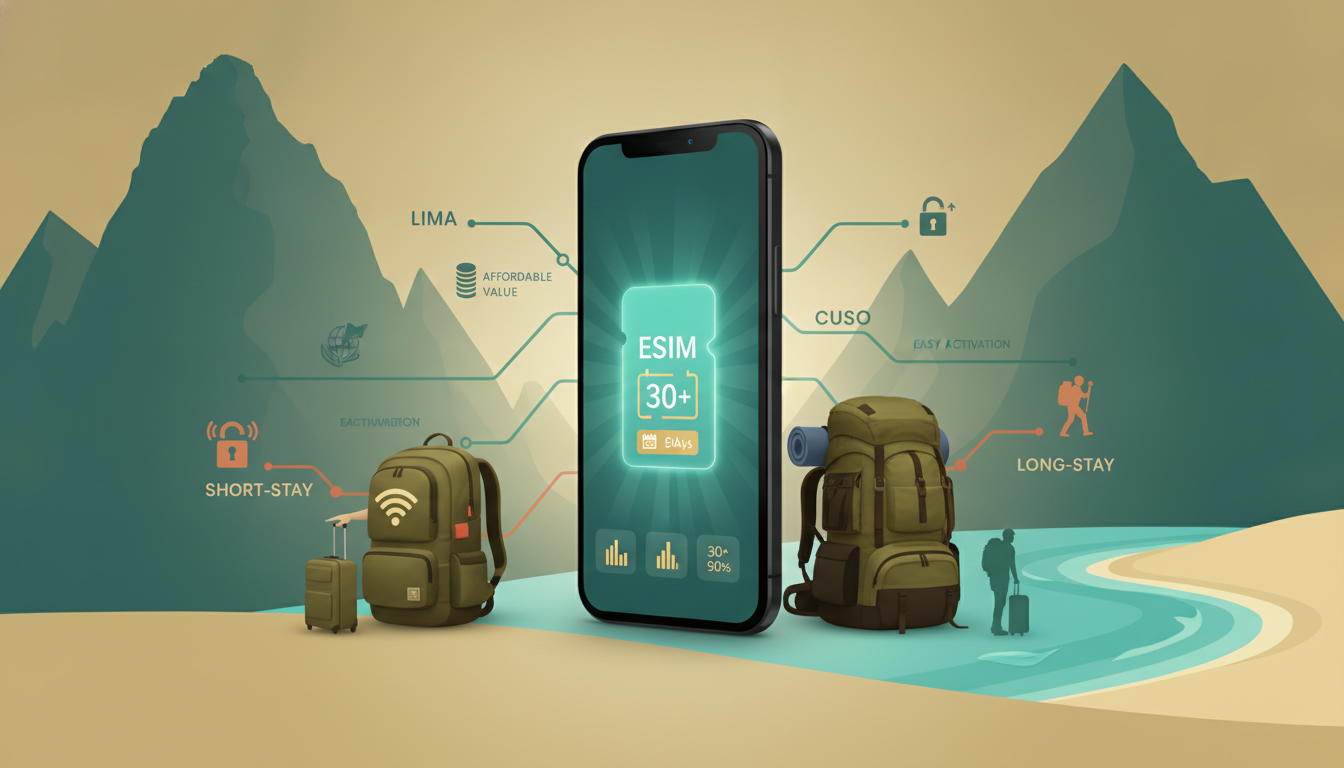
A short Peru trip usually needs a 1–3 GB prepaid eSIM, while a longer stay is better served by a 30-day plan or an unlimited option. Current MyBestSim listings show Peru plans from $2.99 for 3 GB over 1 day to $8.60 for 3 GB over 30 days; the right choice depends less on the lowest price than on validity, network access, and how often you will move between Lima, Cusco, and Machu Picchu.
| Provider | Data | Validity | Price |
|---|---|---|---|
| eSIM.dog | 3 GB | 1 day | $2.99 |
| JamboSim | 3 GB | 30 days | $4.99 |
| Yatelo | 3 GB | 30 days | $5.61 |
| Redtea | 3 GB | 30 days | $6.55 |
| LinkeSIM | 3 GB | 31 days | $6.60 |
| Breeze | 3 GB | 30 days | $6.99 |
| 4S eSIM | 3 GB | 30 days | $7.15 |
| CocoRoam | 3 GB | 30 days | $8.60 |
Short trips need a different buying decision
For a city break, a brief stopover, or a compact Lima–Cusco itinerary, I would start with the validity period rather than the advertised data allowance. A cheap plan that expires after one day is not a bargain if your trip lasts a week.
One to seven days in Peru
The eSIM.dog offer listed by MyBestSim provides 3 GB for 1 day at $2.99. That can make sense for a transit day, airport arrival, or a single day of intensive navigation.
It is not a practical seven-day plan: the data may remain unused while the validity clock has already ended.
For a stay lasting several days, a 30-day plan gives more breathing room. The JamboSim option is listed at $4.99 for 3 GB, while Yatelo is listed at $5.61 for 3 GB.
The difference is only $0.62, so I would not choose between them on price alone. Check the supported Peruvian network, activation conditions, and whether tethering is allowed.
A short-stay traveler normally uses data for:
- Airport transfers and Google Maps
- WhatsApp messages and voice calls
- Translation and restaurant searches
- QR tickets and reservation confirmations
- Occasional photo uploads
When a phone switches repeatedly between weak cells, background applications can consume data while the user thinks the connection is idle. I always disable automatic photo backup and app updates before leaving Wi-Fi; otherwise, a modest travel allowance can disappear through synchronization rather than navigation.
The practical short-stay setup
Install the eSIM before departure, but keep it disabled until arrival. On an iPhone, the path is Settings > Cellular > Add eSIM; Apple’s supported-device requirements still apply, and the phone must be carrier-unlocked.
On Android, the menu varies by manufacturer, but the equivalent option is usually under Network & internet > SIMs > Add eSIM.
Use this sequence:
- Confirm that the phone supports eSIM and is unlocked.
- Install the QR code or activation details while connected to Wi-Fi.
- Label the new line “Peru” so it is not confused with the home SIM.
- Set the Peru eSIM as the mobile-data line after landing.
- Turn data roaming on for the travel eSIM if the provider requires it.
- Keep the primary SIM available for SMS only, with its data roaming disabled.
The sign that setup worked is not merely seeing signal bars. Open a web page with Wi-Fi turned off, confirm that the Peru line shows LTE or 4G, and check that the home SIM has not silently become the data line.
Long stays reward validity and network flexibility
For two to four weeks, the 30-day plans are structurally better than stacking several short plans. The listed options include 3 GB for 30 days from $4.99 to $8.60, plus LinkeSIM at 3 GB for 31 days at $6.60.
That extra day can matter when arrival and departure dates do not align neatly with a calendar month.
| Provider | MyBestSim rank | Rating | Promo code | Discount |
|---|---|---|---|---|
| Yesim | 2 | 4.8/5 | MYBESTSIM20 | 20% unlimited |
| Yatelo | 14 | 4.2/5 | MYBESTSIM | 15% unlimited |
| Maya | 17 | 4.2/5 | MYBESTSIM | 10% unlimited |
| Breeze | 20 | 4.1/5 | MYBESTSIM10 | 10% unlimited |
MyBestSim lists these provider rankings and codes for its comparison offers. A promotion described as “unlimited” still needs careful reading: providers may apply a fair-use policy, reduce speed after a threshold, or restrict hotspot use.
I would check those conditions before selecting an unlimited plan for remote work or video calls.
Lima, Cusco, and the Machu Picchu route
Peru’s mobile coverage is not uniform. Claro, Movistar, Entel, and Bitel operate different networks, and an international eSIM may connect through one local partner rather than all four.
That distinction matters more outside major cities than in central Lima.
In Lima, a plan that works well for airport transfers and hotel navigation is usually easy to test. In the Andes, the outcome can change sharply between the city, the train route, the Sacred Valley, and the entrance area around Machu Picchu.
If the eSIM’s network partner has no usable cell site in a particular valley, changing the phone’s preferred network will not create coverage.
Before choosing, verify:
- The local network partner named by the eSIM provider
- Whether coverage includes Cusco and the Sacred Valley
- Whether data works in the specific Machu Picchu access area
- Whether the plan supports hotspot use
- Whether activation begins on installation or on first connection
A common field mistake is testing an eSIM only in Lima and assuming the same result will apply at altitude. Mountain terrain blocks and reflects radio signals; when a route enters a steep valley, the phone may hold a weak cell for too long, draining its battery while delivering almost no usable data. Downloading offline maps and tickets before leaving Cusco removes that failure point. The best Peru eSIM comparison is most useful when you check the network partner alongside the price.
Activation timing matters more than the QR code
An eSIM is a digital SIM profile, not automatically a local telephone number. Many travel products provide data only, so ordinary cellular calls and SMS may continue to use the home line or require WhatsApp, Signal, or another internet service.
The GSM Association’s Remote SIM Provisioning specification SGP.22 defines the consumer eSIM architecture used for remote profile downloads. In practical terms, the QR code installs a carrier profile; it does not guarantee that the profile has coverage in every Peruvian region.
Install before flying, activate on arrival
The safest pattern is to install while still on reliable Wi-Fi and activate mobile data only when the aircraft has landed. If the plan starts immediately at installation, installing it three days before departure can waste three days of validity.
If it starts on first network connection, early installation is less risky, but the provider’s wording controls.
When the eSIM refuses to connect, the useful checks are concrete:
- Confirm the Peru line is switched on.
- Select it for mobile data.
- Enable data roaming on that line if required.
- Disable automatic network selection briefly and test the available partner networks.
- Restart the phone after changing the network profile.
- Confirm that the access point name matches the provider’s instructions.
If the phone shows “No Service” while another local handset has coverage, the problem may be the eSIM profile, roaming agreement, or selected network rather than the device itself. Do not delete the eSIM during troubleshooting: many providers treat the QR code as single-use.
Choosing the plan for work, streaming, or a month
A 3 GB allowance can be enough for maps, messaging, translation, and light browsing over a short holiday. It becomes restrictive when used for video meetings, cloud backups, social-media uploads, or daily hotspot use.
A video call can consume data far faster than text messaging, while offline map downloads consume data once and then work without a connection.
For a longer trip, compare the cost of repeated prepaid packages with an unlimited offer. MyBestSim lists Roamic at rank 1 with a 4.9/5 rating and a 10% unlimited promotion using MYBESTSIM, and Yesim at rank 2 with a 4.8/5 rating and a 20% unlimited promotion using MYBESTSIM20.
These are separate promotional offers, so check their current eligibility and fair-use terms before payment.
I would avoid paying for unlimited data solely because the label sounds safer. If the trip is mostly offline sightseeing, a 30-day 3 GB plan can be more efficient. If the phone will serve as a laptop hotspot, the provider’s speed policy and tethering rules are more important than the headline allowance. The Peru travel eSIM guide fits that decision because the key issue is usage pattern, not just installation.
One final technical check: dual-SIM phones can keep both lines active, but the home SIM may still incur roaming charges for calls, SMS, or background data. Set the Peru eSIM as the only mobile-data line, disable data switching, and leave the home line active only when you specifically need a verification code.
For trips crossing the 30-day boundary, LinkeSIM’s listed 31-day validity can prevent a renewal gap when the return flight falls one day after a standard monthly plan expires.
FAQ
What data amount suits a short Peru trip?
A 3 GB plan usually covers maps, messaging, translation, reservations, and light browsing during a brief visit. Choose a 30-day validity period for trips lasting several days, because a one-day package may expire before you finish using the included data.
Which Peru eSIM plans last for thirty days?
MyBestSim listings include 3 GB plans valid for 30 days from JamboSim, Yatelo, Redtea, Breeze, and other providers. Prices range from $4.99 to $8.60, while LinkeSIM offers 31 days for $6.60, which may help with travel dates crossing a monthly boundary.
Will an eSIM work near Cusco and Machu Picchu?
Coverage depends on the eSIM’s Peruvian network partner and local infrastructure, not simply the provider’s advertised country coverage. Check support for Cusco, the Sacred Valley, train routes, and the Machu Picchu access area, then download maps and tickets offline before entering weak-signal regions.
When should travelers install and activate their eSIM?
Install the eSIM on reliable Wi-Fi before departure, but activate mobile data after landing unless the provider says validity begins during installation. Set the travel eSIM as the data line, enable roaming if required, and test a webpage with Wi-Fi disabled.
Is unlimited data better than a 3 GB Peru plan?
Unlimited data makes more sense for frequent hotspot use, video meetings, streaming, or remote work, provided fair-use and tethering rules are acceptable. For sightseeing with offline maps and messaging, a 30-day 3 GB package usually costs less and provides sufficient everyday connectivity.

Diego Ramirez
Diego is a South America travel writer. At Peru eSIM he compares Claro, Movistar, Entel and Bitel coverage from Lima to Machu Picchu.