Esimx Data Plans for Short vs Long Stays in Peru in 2026
10/16/2026
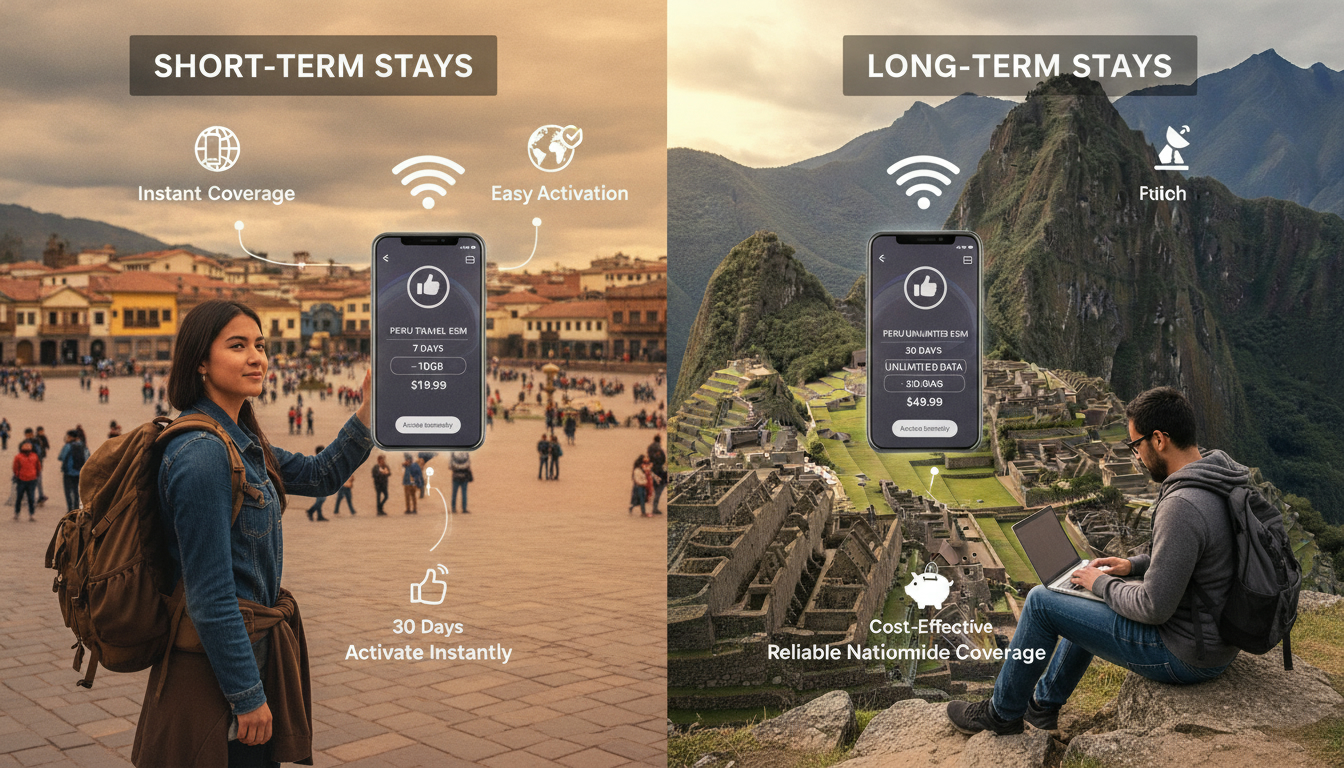
Comparing eSIMX Data Plans for Short-Term and Long-Term Stays in Peru
Choosing the right eSIM data plan in Peru depends heavily on how long you plan to stay. For short-term visitors, a daily or weekly plan with flexible activation is key, while long-term travelers benefit from monthly plans offering better value and stable coverage.
The eSIMX platform provides options that cater to both needs, but understanding how duration affects pricing, coverage, and activation can save you money and hassle during your trip.
How Duration Influences eSIM Data Plans in Peru
The length of your stay directly impacts which eSIM data plan is most suitable. Short stays require quick activation and minimal commitment, while longer stays demand plans with larger data allowances and cost efficiency.
Short-Term Stays: Flexibility and Instant Activation
For trips lasting a few days up to a week, short-term eSIM plans are ideal. These typically offer:
- Low data caps (around 1 GB to 3 GB) that cover essential browsing and messaging.
- Instant activation, allowing you to download the eSIM profile immediately upon purchase.
- No long-term contracts, so you can avoid paying for unused data.
One field observation I often make is that travelers who activate their eSIM too early risk wasting data before arrival. The mechanism here is that the eSIM profile’s validity period starts counting down from activation, not download.
The consequence is losing days of connectivity without use. To avoid this, I always advise activating the eSIM once you land in Peru or are ready to use it.
Long-Term Stays: Cost Efficiency and Coverage Stability
If your stay extends beyond a month, monthly or multi-month plans provide better value per gigabyte. They typically include:
- Larger data allowances (3 GB or more per month).
- Stable network coverage through partnerships with major Peruvian carriers like Claro, Movistar, Entel, and Bitel.
- Possibility of automatic renewal or easy top-ups.
A critical mechanism to understand here is that some long-term plans throttle speeds after a certain data threshold to manage network load. For example, exceeding 3 GB might reduce your speed from 4G LTE to 3G.
This throttling affects streaming or video calls but keeps basic connectivity intact. Knowing this helps set realistic expectations for your usage.
Activation Process and Device Compatibility with eSIMX
Using eSIMX requires a compatible device and understanding the activation steps, which differ slightly depending on your stay duration.
Compatible Devices and Dual SIM Setup
eSIM technology works on devices that support embedded SIM profiles such as recent iPhone models (iPhone XS and later), Google Pixel phones (Pixel 3 and later), and some Samsung Galaxy devices. A dual SIM setup allows you to keep your original SIM active while using an eSIM for local data.
One practical insight is that not all devices allow simultaneous use of two active SIMs for data; some switch automatically based on settings. This mechanism means you must configure your device carefully to avoid losing connectivity when switching between networks.
Step-by-Step Activation for Short vs. Long Stays
The eSIM activation process involves scanning a QR code or manually entering an activation code provided after purchase. For short stays, I recommend:
- Purchasing the plan shortly before arrival.
- Downloading the eSIM profile but delaying activation until you reach Peru.
- Activating the plan when you need it to maximize validity.
For long stays:
- Purchase a monthly or multi-month plan.
- Activate immediately upon arrival.
- Monitor data usage regularly to avoid throttling or unexpected cutoffs.
The GSMA specification SGP.22 governs remote eSIM provisioning, ensuring interoperability across carriers and devices worldwide, which makes this process standardized but still device-dependent.
Pricing Considerations: What Duration Means for Your Budget
Pricing varies significantly between short-term and long-term plans on platforms like eSIMX and others listed by MyBestSim.
| Provider | Data Allowance | Validity | Price (USD) | Promo Code | MyBestSim Rank | Rating |
|---|---|---|---|---|---|---|
| eSIM.dog | 3 GB | 1 day | $2.99 | MYBEST15 | 35 | 4/5 |
| JamboSim | 3 GB | 30 days | $4.99 | MYBESTSIM | 19 | 4/5 |
| Yatelo | 3 GB | 30 days | $5.61 | MYBEST15 | 12 | 4.2/5 |
| Redtea | 3 GB | 30 days | $6.55 | MYBESTSIM | - | - |
| LinkeSIM | 3 GB | 31 days | $6.60 | MYBESTSIM | - | - |
This table shows that daily plans like eSIM.dog’s offer immediate access at a higher per-GB cost but no commitment beyond one day—perfect for brief visits or emergencies. Monthly plans from JamboSim or Yatelo provide better value for longer stays but require upfront commitment.
One trade-off I observe is that short-term plans often lack unlimited options, while long-term plans sometimes offer unlimited data at discounted rates with promo codes like "MYBEST15" for eSIMX users, which can reduce costs by up to 15%.
Coverage Quality: How Duration Affects Network Experience
Coverage quality in Peru varies by region and operator, influencing which plan suits your stay length.
Urban vs Rural Coverage Dynamics
In Lima and Cusco, all major carriers provide strong LTE coverage suitable for streaming and video calls. However, in remote areas like Machu Picchu or the Amazon basin:
- Some operators have limited LTE availability.
- Data speeds can drop due to network congestion or terrain obstacles.
For short stays focused on urban tourism, any major operator’s plan suffices because coverage is dense and reliable.
For long-term travelers planning excursions into rural zones, choosing an operator with broad national coverage matters more. Claro and Movistar generally have wider rural reach than Bitel or Entel.
Impact of Plan Duration on Network Support
Longer-duration plans often come with better carrier support agreements because operators prioritize customers with sustained subscriptions over transient users. This means:
- Faster troubleshooting response times.
- Access to priority network resources during peak hours.
- More stable connections due to optimized routing.
Short-term users may experience slower customer service response since their accounts are temporary.
Why Choose eSIMX Over Traditional SIM Cards?
eSIMX leverages the benefits of the eSIM technology standard to improve traveler connectivity in Peru compared to physical SIM cards.
Benefits of Using an eSIM Data Plan
- No physical SIM swapping: You avoid losing your original number or risking damage during SIM changes.
- Instant profile download: The GSMA SGP.22 standard enables remote provisioning without visiting a store.
- Multiple profiles management: A dual SIM eSIM setup lets you keep home and local lines active simultaneously.
- Better security: Embedded profiles reduce risks of SIM card theft or cloning compared to physical cards.
A common mistake travelers make is assuming all phones support eSIMs; lacking a compatible device means they cannot use these benefits at all.
The Future of eSIM Connectivity in Travel
The global push toward embedded SIMs means services like eSIMX will expand their offerings rapidly across destinations including Peru. As carriers adopt GSMA-compliant provisioning methods widely, expect:
- More flexible plans tailored by duration.
- Improved interoperability between devices and networks.
- Seamless switching between providers without physical cards.
This evolution will make managing connectivity during travel simpler but requires travelers to understand their device capabilities fully beforehand.
Additional Tips for Using eSIMX During Your Peru Trip
When preparing your phone for an eSIMX plan in Peru:
- Check if your device supports dual SIM functionality; this affects whether you can keep your original line active alongside the Peruvian data plan.
- Download the latest carrier settings update before departure; outdated settings can cause activation failures.
- Monitor your data usage daily if on a monthly plan with throttling thresholds; exceeding limits reduces speed significantly but does not cut off service entirely.
For detailed insights about Peruvian travel connectivity options including instant activation offers from Claro, Movistar, Entel, and Bitel networks, see this comparison of best Peruvian eSIM offers.
Understanding these nuances will help you choose the right esimx data plan tailored specifically to how long you’ll be exploring Peru without overspending or losing connection at critical moments.
FAQ
What devices are compatible with esimx in Peru?
eSIMX works on devices supporting embedded SIM profiles like iPhone XS and later, Google Pixel 3 and newer, and some Samsung Galaxy models. Compatibility ensures you can use dual SIM setups to keep your original number active while using local data.
How does esimx activation differ for short and long stays?
For short stays, activate your eSIMX plan upon arrival to maximize validity. Long-term users should activate immediately and monitor data usage to avoid throttling. Activation involves scanning a QR code or entering a code provided after purchase.
What are the cost differences between short and long-term esimx plans?
Short-term esimx plans have higher per-GB costs but no long-term commitment, ideal for brief visits. Long-term plans offer larger data allowances at better rates but require upfront commitment, often with options for automatic renewal or top-ups.
How does stay duration affect network coverage with esimx?
Short stays in urban areas benefit from dense LTE coverage by major carriers. Long-term travelers venturing into rural Peru should choose plans from operators like Claro or Movistar for broader coverage and more stable connections.
Why choose esimx over traditional physical SIM cards?
eSIMX eliminates physical SIM swapping, offers instant profile downloads, supports multiple profiles on one device, and enhances security against theft or cloning. It simplifies connectivity management, especially for travelers needing flexible and reliable data access.

Diego Ramirez
Diego is a South America travel writer. At Peru eSIM he compares Claro, Movistar, Entel and Bitel coverage from Lima to Machu Picchu.