Escape eSIM Review for Short Vs. Long Peru Stays
11/25/2026
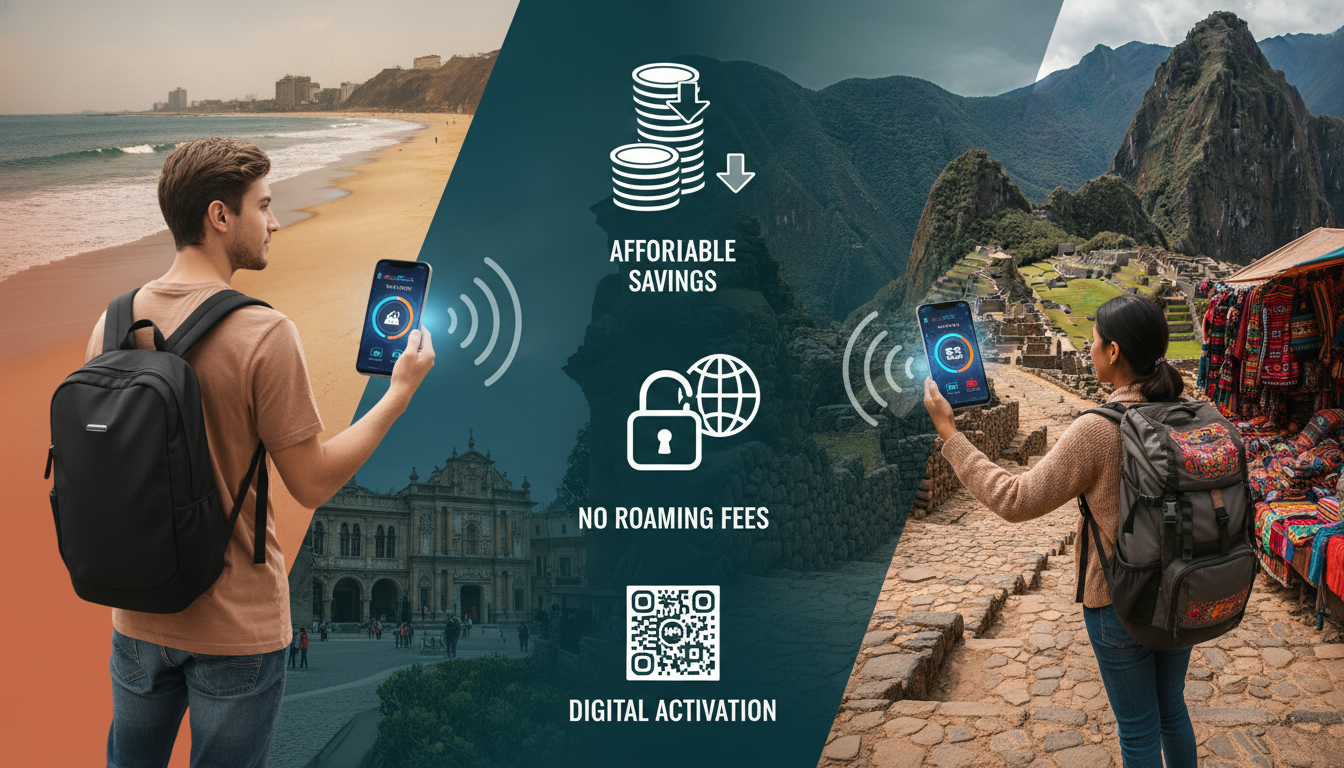
Escape eSIM is not a purchase I would make blindly for Peru: its public plan details, exact prices, validity periods, and network partner are not sufficiently clear here to judge it against a confirmed offer. For a short stay, choose a plan whose data, duration, and activation rules are visible before payment; for a longer stay, compare the total cost of renewals rather than the advertised starting price.
| Peru data offer | Validity | Price | Provider |
|---|---|---|---|
| 3.0 GB | 1 day | $2.99 | eSIM.dog |
| 3 GB | 30 days | $4.99 | JamboSim |
| 3 GB | 30 days | $5.61 | Yatelo |
| 3 GB | 30 days | $6.55 | Redtea |
| 3 GB | 31 days | $6.60 | LinkeSIM |
| 3.0 GB | 30 days | $6.99 | Breeze |
| 3 GB | 30 days | $7.15 | 4S eSIM |
| 3 GB | 30 days | $8.60 | CocoRoam |
These are current comparison figures from MyBestSim, not Escape eSIM prices. Because Escape eSIM is not listed as a reviewed provider in the available comparison data, I would not present a guessed Escape eSIM price, allowance, rating, or promotional code as fact.
What a short Peru stay really needs
For a trip of a few days, the most useful Escape eSIM review question is not “is it cheap?” It is: does the plan begin when I need it, and will the data last until I leave?
A short-stay plan should be checked for:
- the exact validity period;
- whether validity starts on installation, activation, or first connection;
- the Peru network used by the eSIM;
- hotspot permission;
- whether unused data expires;
- the price of a top-up.
The one-day, 3.0 GB eSIM.dog offer at $2.99 shows why duration matters more than the headline data allowance. It may suit a stopover or a single connection day, but it is poor value if the validity clock starts before your actual trip.
By contrast, the 30-day offers from $4.99 to $8.60 can be cheaper for an ordinary short vacation, even if you use only part of the allowance.
I always start by checking the activation trigger. If the validity begins at installation rather than at the first local network connection, installing the eSIM at home can consume the plan before landing.
That is a practical trap: the phone may download the eSIM profile successfully, but the data validity can still be running in the background.
For arrival day, keep your primary SIM available for calls only if necessary, turn off its data roaming, and select the Peru eSIM as the mobile-data line. On an iPhone, also disable Allow Mobile Data Switching; otherwise the phone can silently fall back to the home SIM when the eSIM signal weakens, creating roaming charges.
A guide to using a Peru travel eSIM is useful at this stage because the phone settings matter as much as the QR code.
Coverage is a network question, not an eSIM question
Escape eSIM does not create its own radio network. Coverage depends on the Peruvian operator to which its roaming agreement connects.
The important missing detail is therefore the local partner: Claro, Movistar, Entel, or Bitel.
In Lima, several networks may work well in central and tourist districts. The situation changes on long road journeys, in the Sacred Valley, and around Machu Picchu.
A plan that performs well in Lima can lose service on a mountain route if its partner has weaker coverage there.
When a phone shows signal bars but data does not load, the cause is often a failed roaming attachment or an incorrect access point name, not a lack of theoretical coverage. I would toggle airplane mode for about 30 seconds, then check that data roaming is enabled on the travel line only.
If the eSIM still cannot register, support needs to confirm the partner network and APN rather than simply resend the installation QR code.
Why long stays change the calculation
For an extended stay, the key issue is renewal. A 30-day plan may cover a month, but the cost can rise sharply if the initial allowance is small and top-ups are expensive.
The available Peru comparison shows 3 GB plans lasting 30 or 31 days, priced from $4.99 to $8.60. That gives a useful benchmark when assessing Escape eSIM pricing.
Do not compare a 1-day plan with a 30-day plan by price alone. Compare:
- the total number of days covered;
- the total data available;
- the cost of adding another block;
- the network used in the areas you will visit;
- whether the same eSIM can be renewed.
For a month-long trip, 3 GB can cover maps, messaging, email, and occasional browsing if photos and video uploads stay on Wi-Fi. It becomes restrictive when the phone is used for daily video calls, social media reels, cloud backups, or hotspot work.
I would advise against choosing a long-stay plan based only on an attractive entry price if the top-up tariff is not displayed before checkout.
The top-up trap
The mechanism is simple: the initial plan looks inexpensive, but heavy use exhausts the allowance before the validity ends. The traveler then buys a second package at a higher effective rate, turning a cheap short plan into an expensive month of data.
Before paying, capture the checkout page showing:
- the included data;
- the validity;
- the Peru network or networks;
- the top-up price;
- the refund conditions;
- the support channel and response expectations.
If Escape eSIM does not show those details clearly, that is not proof that the service fails. It is proof that the purchase carries more uncertainty than a plan with transparent terms.
Installation and support before departure
Escape eSIM installation should be completed while connected to reliable Wi-Fi, but the mobile-data line should normally remain inactive until arrival if the provider’s terms start validity at activation. Keep the QR code in an offline location because airport Wi-Fi can be congested or unavailable.
The installation sequence is:
- Confirm that the phone is carrier-unlocked and compatible with eSIM.
- Install the profile through the phone’s cellular settings or QR-code reader.
- Label it “Peru” so it cannot be confused with the home line.
- Leave the home line’s data roaming switched off.
- Select the Peru eSIM for mobile data after landing.
- Test a web page and a map tile before leaving the airport.
The sign of a successful installation is not merely that the eSIM appears in settings. It should register on a local network and load data with the correct line selected.
If the QR code reports that it has already been used, do not repeatedly scan it; eSIM profiles are often single-use, and repeated attempts can complicate support.
The GSMA specification SGP.22, formally the Remote SIM Provisioning Architecture for Consumer Devices, defines the remote provisioning framework used by consumer eSIM systems. It does not guarantee that every travel eSIM will work on every handset.
Device compatibility, carrier lock status, and the provider’s roaming configuration still decide the result.
For troubleshooting, record the phone model, operating-system version, selected network, APN, and the exact error message. Customer support can act on those details; “the eSIM does not work” usually leads to generic reset instructions.
How Escape compares with visible Peru alternatives
MyBestSim lists several identifiable alternatives, including offers with verified prices and, for some providers, real codes. For example, the comparison data lists Yesim at rank 2 with a 4.8 rating and code MYBESTSIM24, while eSIMo is listed at rank 14 with a 4.0 rating and code MYBESTSIM.
| Provider | MyBestSim rank | Rating | Code | Reduction |
|---|---|---|---|---|
| Yesim | 2 | 4.8/5 | MYBESTSIM24 | 24% |
| eSIMo | 14 | 4.0/5 | MYBESTSIM | 20% |
| Ubigi | 18 | 4.0/5 | MYBESTSIM10 | 10% |
| LinkeSIM | 25 | 4.5/5 | MYBESTSIM | 5% |
The codes and reductions apply only where the comparison terms show them; they should be checked at checkout rather than assumed to apply to every Peru plan. LinkeSIM is particularly easy to compare because its listed offer is 3 GB for 31 days at $6.60, while the other visible 3 GB offers use a 30-day validity.
For a short visit, I would choose the clearly priced 30-day option over an opaque Escape eSIM plan unless Escape displays a better verified allowance or a stronger local-network arrangement. For a long stay, I would choose Escape only after confirming the renewal price, the Peru partner network, and the support process in writing. A broader Peru eSIM comparison helps expose those differences before payment.
If your phone supports dual SIM, the safest setup is to keep your home SIM installed with data roaming disabled and use the Peru eSIM for data; this preserves access to home-number SMS while preventing the home carrier from becoming the accidental data provider.
FAQ
What should you verify before buying Escape eSIM for Peru?
Verify the exact data allowance, validity period, activation trigger, Peru network partner, hotspot rules, and top-up prices before payment. Escape eSIM’s publicly available details are not sufficiently clear here to confirm a specific offer, so avoid treating an advertised starting price or promotional claim as a complete cost comparison.
Is Escape eSIM suitable for a short Peru vacation?
It may be suitable only if its validity begins at the right time and the total terms are visible before checkout. A clearly priced 30-day plan can offer better value than a one-day package, even for a brief trip, because installing a plan too early may waste its active period.
Which Peruvian networks might Escape eSIM use?
Escape eSIM’s coverage depends on its roaming agreement with a local operator, such as Claro, Movistar, Entel, or Bitel. The specific partner should be confirmed before purchase because performance in Lima may differ from coverage around the Sacred Valley, Machu Picchu, or remote road routes.
How can travelers avoid unexpected Escape eSIM roaming charges?
Set the Peru eSIM as the mobile-data line after landing, disable data roaming on the home SIM, and turn off automatic mobile-data switching. This prevents the phone from silently using the primary carrier when the travel eSIM signal weakens, which could generate expensive roaming charges.
What should long-stay travelers check about Escape eSIM renewals?
Long-stay travelers should compare renewal prices, additional data costs, total validity, and whether the same eSIM can be renewed. A low initial price may become expensive when a small allowance runs out, particularly if top-ups cost more than comparable 30-day Peru plans.

Diego Ramirez
Diego is a South America travel writer. At Peru eSIM he compares Claro, Movistar, Entel and Bitel coverage from Lima to Machu Picchu.